
The conversation often starts with a question that sounds simple: do I need a custom website, or will a template do the job?
My answer rarely starts with technology. It starts with another question: what must the website achieve for the investment to be worthwhile?
A template is not automatically a cheap compromise, and a custom website is not automatically a smart investment. I have seen carefully chosen templates make a launch remarkably effective. I have also seen bespoke projects spend time and budget on details that made no difference to the business.
The right decision is not about which option sounds more professional. It depends on where the project needs to be different and what its limitations would cost.
The short answer
A template is often enough when a business needs to validate an idea, launch quickly and use a relatively conventional structure.
Custom web design starts to make sense when explaining the offer, structuring the content, connecting systems or building trust is part of the competitive advantage.
There is also a productive middle ground: start with a robust system and deeply customise only the elements that genuinely need to be unique.
Not everything has to be designed from scratch to be well designed.
What using a template actually means
The word template covers very different products and processes.
It might mean buying a theme, installing it with minimal changes and filling the available spaces with copy and images. It can also mean using a carefully engineered foundation that a professional adapts to a company’s identity, content and goals.
In the first case, the business adapts to the template. In the second, the template is a starting point that adapts to the business within known boundaries.
A strong template can already solve repeatable decisions such as:
- responsive behaviour;
- typographic hierarchy;
- navigation and common components;
- interaction states;
- basic technical structure;
- accessibility and performance patterns.
 Infinite / PortaleFintech and digital banking
 Ion 7 OpticsNeurotechnology and wearables
Nexus / CircleCreative communities
Ion 7 OpticsNeurotechnology and wearables
Nexus / CircleCreative communities
 Tesla Model ThreeElectric mobility
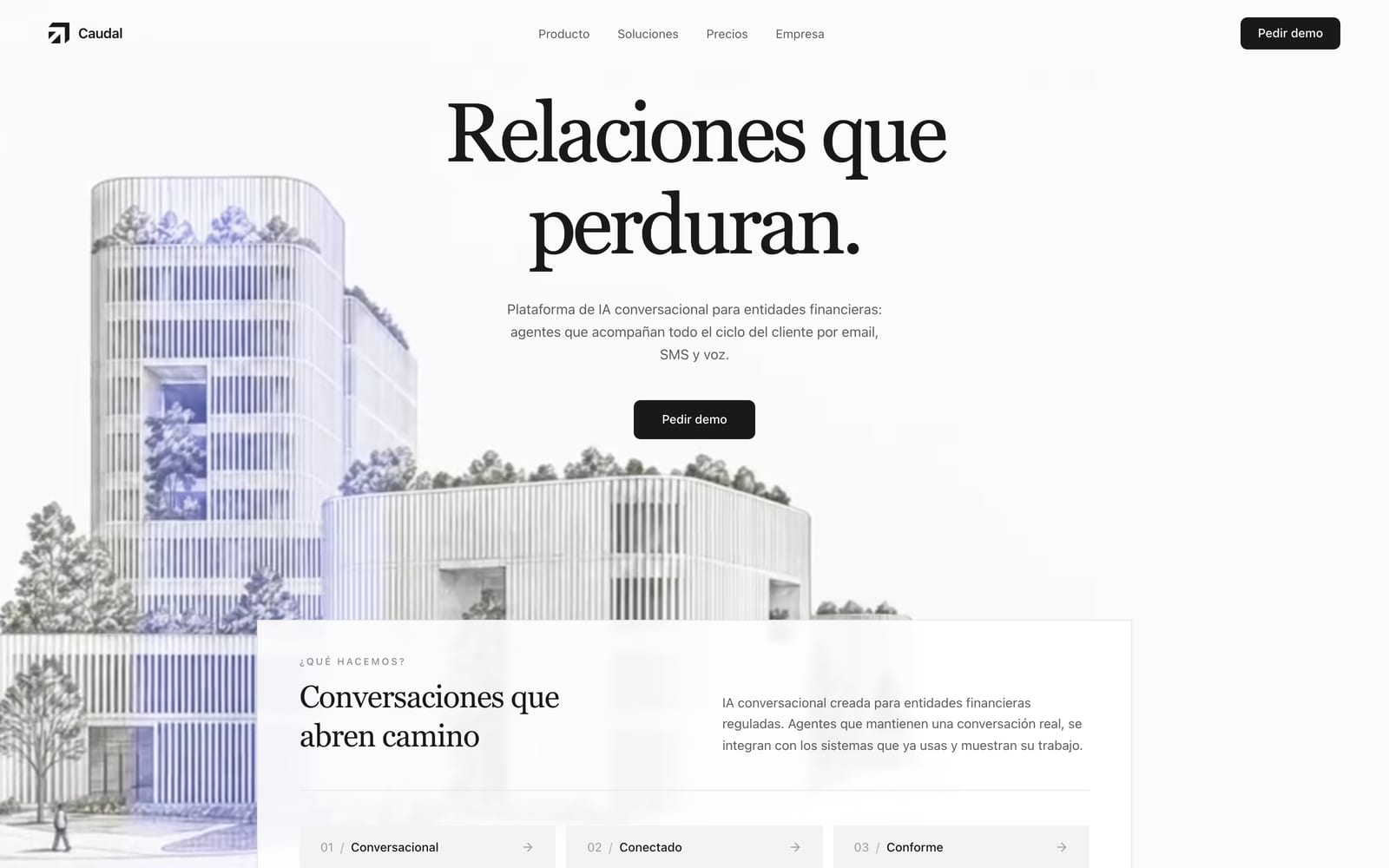 CaudalBanking and financial services
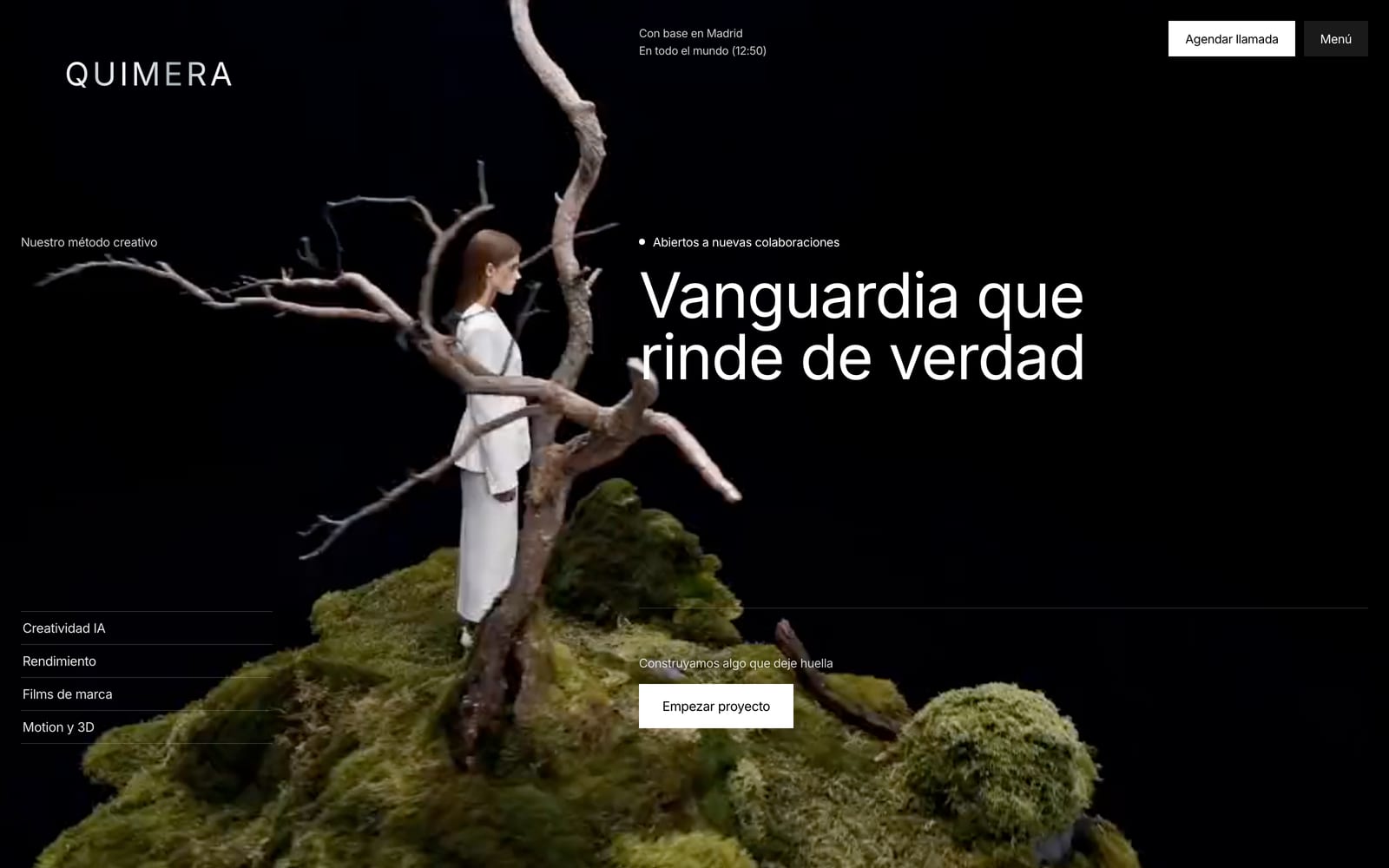 QuimeraCreative studios and production
 PupilaOpticians and independent eyewear
 RiscoTechnical outdoor and mountain gear
Reusing those decisions does not reduce the value of the work. The problem begins when the company’s proposition needs a different structure and is forced into the blocks that happen to be available.
That is when the patches appear: an important message hidden in the wrong section, features added through a chain of plugins and a visual identity that feels too similar to every competitor.
What custom web design should provide
“Custom” should not simply mean changing colours, typefaces and animations. Nor should it mean drawing every button from a blank page just to justify more hours.
A bespoke project creates value when it enables better decisions about:
- what the visitor needs to understand first;
- how a complex offer becomes a clear story;
- what evidence someone needs before getting in touch;
- which journey leads each audience to the right action;
- what components the team needs to publish and grow;
- how the website connects to the way the business actually operates.
The meaningful difference is structural, not merely visual.
Good custom design connects strategy, information architecture, interface and development. That is why I prefer to build systems before isolated screens: the decisions should still work when the website gains new pages, campaigns or services.
Five criteria for making the decision
1. Differentiation
If the business is easy to explain and its sector relies on familiar patterns, a template can provide enough differentiation through strong art direction and content.
If the company sells a complex service, enters a crowded market or needs to change how it is perceived, structure and visual language become part of the strategy. In that context, looking like everyone else has a cost.
The useful question is: does the website only need to establish a presence, or must it change a perception?
2. Content and architecture
A template works best when the content fits naturally into a familiar structure: home, services, about, projects and contact.
When there are several audiences, long buying cycles, many use cases or an offer that is difficult to compare, the architecture should be designed around those decisions.
Forcing content to occupy the available space reverses the process. First decide what the page needs to communicate; then choose or build the component.
3. Functionality and integrations
A contact form, newsletter or straightforward catalogue can be handled well by many existing solutions.
But if the website must communicate with a CRM, display proprietary data, manage bookings, personalise journeys or integrate with internal processes, the interface is only one part of the problem. The whole system deserves consideration.
Adding plugins until a template performs a job it was never designed for can look affordable at first and later become a chain of incompatibilities and maintenance work.
4. Performance and maintenance
Not every template is slow, and not every custom website is fast. The result depends on how it is built, what resources it loads and how consistently it is maintained.
A simple, well-engineered foundation can perform exceptionally well. A template overloaded with page builders, animations and unnecessary extensions can end up shipping far more code than the page requires.
In my work, the frontend stack is part of the design decision, because it affects speed, editing and long-term evolution well after launch.
5. The stage of the business
A company that is still validating its offer needs to learn quickly. Investing in a complex platform on day one can lock in decisions that should still be easy to change.
At that stage, a focused landing page or a well-adapted template makes it possible to launch, observe and adjust.
Once the business understands its customer, has validated the proposition and knows that the existing website limits sales or operations, custom design is no longer an aesthetic bet. It becomes infrastructure.
A practical comparison
| Criterion | Adapted template | Custom design |
|---|---|---|
| Launch | Faster when content is ready | Needs a deeper definition phase |
| Initial investment | Usually lower | Higher due to strategy, design and development |
| Differentiation | Shaped by the starting system | Built around the brand and proposition |
| Functionality | Effective for conventional requirements | Suited to proprietary flows and integrations |
| Scalability | Strong within anticipated boundaries | Designed around a specific roadmap |
| Main risk | Forcing the business into the template | Overdesigning before needs are validated |
The comparison provides direction, but one variable matters more: the cost of choosing badly.
If a template allows a business to validate its offer three months earlier, that speed may be more valuable than a completely distinctive identity. If a generic website makes a high-value service look interchangeable, the initial saving can become expensive with every lost opportunity.
When I would choose a template
I would recommend a carefully adapted template when:
- there is a near-term launch date;
- the budget should first go into content, photography or acquisition;
- the offer is still evolving;
- the required features are conventional;
- the team is comfortable working within a defined system;
- the website is a first version rather than the final platform.
Professional judgement still matters in these situations. Choosing the right foundation, removing unnecessary features, adapting the identity, improving the content and checking performance separates an effective solution from a template that has simply been filled in.
When I would invest in custom design
I would recommend it when:
- brand perception directly influences the sale;
- the proposition needs its own narrative;
- there are several audiences or journeys;
- the website must integrate with internal tools and processes;
- the content is expected to grow significantly;
- the business knows what it needs to improve and can measure it;
- a limitation of the current website is already blocking real opportunities.
Before reaching that point, it is worth checking that the organisation is ready. In these warning signs before a redesign, I explain why a website cannot fix a confused offer or an undefined internal process by itself.
The hybrid route: customise where it matters
There is a very productive space between installing a theme without judgement and designing everything from zero.
A project can start from a proven technical architecture, component system or high-quality theme and focus custom work on:
- the value proposition;
- content architecture;
- the pages with the greatest commercial impact;
- visual direction;
- interactions that explain the product;
- integrations that save the team time.
This approach reduces time spent on common decisions and protects the budget for the problems that are genuinely specific.
It still demands honesty. If every component must be changed, the navigation rebuilt and the original foundation constantly fought against, there is no longer a saving. The project is paying to dismantle a template before building the real solution.
How I make the decision in a project
I do not begin by recommending a technology. I first review four elements:
- Goal: what business change the website must create.
- Content: what needs to be explained and to whom.
- Operations: which systems and people it must work with.
- Horizon: what needs to work now and what may be added later.
With that map, it becomes much easier to decide where to reuse, where to adapt and where to design from scratch.
It also prevents one of the worst possible outcomes: paying for custom design and receiving a disguised template, or buying a cheap template that needs months of patches.
The best option leaves resources for what matters
A website does not become valuable because of the number of original elements it contains. It creates value when it communicates clearly, builds trust, works well and remains maintainable.
Sometimes a carefully chosen template achieves that. At other times, the project needs its own architecture and interface. Professional judgement means recognising the difference before spending the budget.
If you are weighing both options, tell me about the project. We can identify what genuinely needs to be unique and what is better solved with a proven foundation.
Have a project in mind?
Let's talk about how I can help you achieve your goals and scale your business.